AI Is Changing EU Project Writing — But It Is Not Replacing the Project Writer
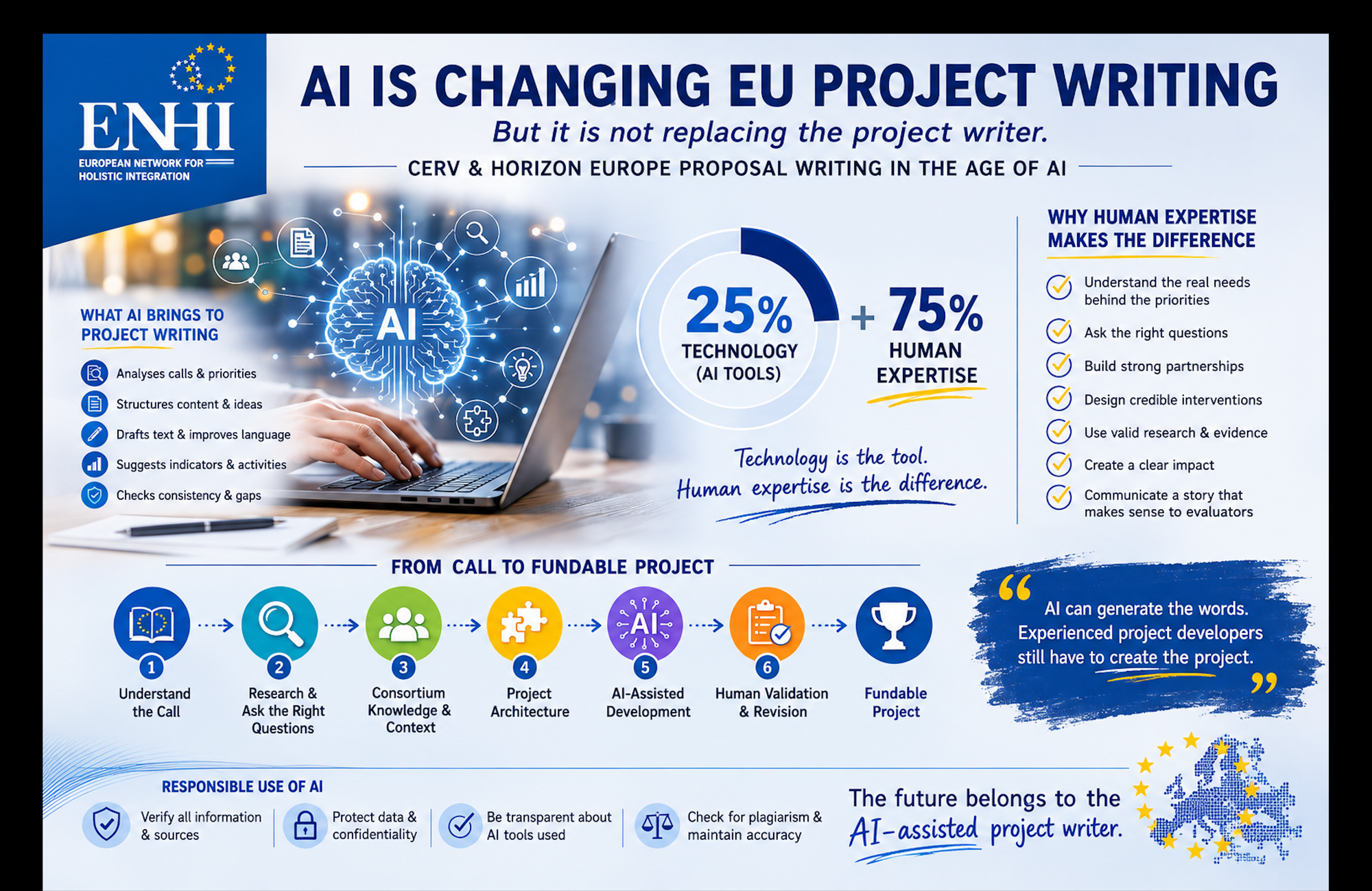
CERV and Horizon Europe proposal writing in the age of generative AI
Artificial intelligence is rapidly changing the way European project proposals are developed. Large Language Models (LLMs) can analyse extensive documents, structure information, compare priorities, improve language, generate first drafts and help applicants navigate complex calls such as CERV and Horizon Europe. This is no longer a marginal practice. A 2026 study from the European Commission's Joint Research Centre examining Horizon Europe applications found that, by the end of 2024, around 40% of proposal abstracts submitted by firms showed signs of LLM-assisted writing. But this raises an important question: If AI can read the call and write the text, do we still need experienced project writers?
The answer is very clearly yes. There is no magic percentage of "AI allowed" One misconception is that the European Commission allows only a certain percentage of AI-generated text—for example 10%, 20% or 30%. This is not how the current rules work. For example, the 2026 CERV Gender Equality call explicitly addresses the use of generative AI in preparing proposals.
Applicants are required to carefully review and validate AI-generated content, verify its accuracy and sources, check for plagiarism, protect personal and confidential information, acknowledge AI limitations and be transparent about which AI tools were used and how. Ultimately, the applicant remains fully responsible for the proposal.
There is therefore an important distinction: The question is not simply "How much AI did you use?" The more important questions are: Is the proposal accurate? Is the evidence real? Are the sources valid? Does the intervention respond to an actual need? Are the partners capable of delivering it? And does the project genuinely respond to the call? Uploading a call into AI does not create a good project This is perhaps the biggest misunderstanding about AI-assisted proposal writing. You can upload a 70-page CERV call to an AI system and ask: "Develop a project proposal that matches this call." Within seconds, the system may produce an impressive-looking concept with objectives, target groups, work packages, activities, deliverables, indicators and impact statements. It may even look like a European project.
But looking like a project and being a fundable project are two very different things. AI is extremely good at identifying patterns. If the call repeatedly mentions gender equality, civic participation, capacity building, European cooperation, fundamental rights and vulnerable groups, an LLM can generate a project containing exactly those concepts. The problem is that evaluators are not simply looking for a text that repeats the terminology of the call. They are evaluating whether there is a convincing intervention behind that text. The Commission itself reminds applicants that each call has its own requirements and evaluation criteria and that proposals must closely follow them.
The project writer's job is increasingly becoming the job of asking the right questions This is where experienced project developers become even more important. The project writer should not simply ask AI: "Write WP2." Before writing WP2, someone needs to ask: What problem are we actually solving? How do we know this problem exists? Who experiences it? What research supports our assumptions? What have previous EU-funded projects already done? What is missing? Why are these particular partners necessary? What does Sweden contribute that Romania, Germany or Greece cannot? Why does this require European cooperation? What changes for the target group after 24 or 36 months?
How will we measure that change? What happens after the EU funding ends? And perhaps one of the most important questions: Why should the European Commission fund this project rather than another proposal addressing the same priority? An AI system can help answer these questions. But an experienced project developer must know which questions need to be asked in the first place. AI does not know your consortium This becomes particularly important in large Horizon Europe and CERV proposals. AI may suggest that Partner 3 should lead a work package on policy advocacy because that produces a logically coherent proposal. But does Partner 3 actually have that expertise? Does it have sufficient staff? Has it implemented similar activities? Does its organisational strategy support that role? Can it realistically deliver 15 national workshops? Does its budget correspond to its responsibilities? Has the organisation even agreed to do it? These are human and organisational questions. The same applies to research and needs analysis. An LLM can identify potentially relevant studies extremely quickly, but applicants must verify the accuracy, validity and appropriateness of AI-generated information and citations. The Commission explicitly places that responsibility on the applicant. AI can help find the evidence.
The consortium must make sure that the evidence is true. The danger of the "perfect AI proposal" There is another interesting problem emerging. AI can produce proposals that are grammatically excellent, perfectly structured—and completely forgettable. We increasingly encounter sentences such as: "The project will foster an innovative, inclusive and sustainable ecosystem empowering vulnerable stakeholders through capacity building, knowledge exchange and cross-sectoral cooperation at European level." There is nothing grammatically wrong with this sentence. There is also almost nothing useful in it. A good evaluator needs to understand: Who? What? How many? Where? Why? By when? What will change? How will we know? A strong project writer transforms abstract EU terminology into an intervention that a human evaluator can visualise. Instead of: "We will empower women's organisations." we need something closer to: "120 representatives of grassroots women's organisations in six countries will participate in Civic Labs identifying barriers to participation. The resulting evidence will feed into six national advocacy briefs and one European policy paper presented to national and EU-level stakeholders." Now the evaluator can see the intervention. AI should support project architecture—not replace it The most productive way to use AI for CERV and Horizon proposals is therefore not: Call → AI → Proposal but rather: Call → Human analysis → Research → Consortium knowledge → Project architecture → AI-assisted development → Human validation → Evaluator-oriented revision → Final proposal AI can be extremely powerful at several points in this process. It can analyse the call, map requirements, compare sections, identify inconsistencies, structure work packages, improve language, challenge assumptions, develop indicator options, analyse risks, test intervention logic and even simulate an evaluator's questions. But the strategic decisions still need human judgement.
AI tools may be 25% of the advantage. The rest is project intelligence. I sometimes describe the technology as approximately 25% of the competitive advantage in proposal development. This is not a European Commission statistic, and it should not be interpreted as a scientific formula. It is a practical way of describing what I see happening in proposal development. Having good AI tools, specialised software and AI agents certainly matters. But the remaining 75% comes from things technology cannot automatically provide: experience, strategic thinking, understanding the programme, consortium quality, organisational knowledge, credible evidence, intervention design, budget logic, political and social context, stakeholder understanding, and the ability to tell a complex project story that makes sense to another human being.
Interestingly, the Commission's own JRC research provides a warning against assuming that more AI automatically means better proposals. Its Horizon Europe study found that proposals relying extensively on LLM-generated text were associated with lower evaluation scores and funding probabilities in cross-sectional analysis, while partial LLM assistance showed only a weak relationship. Importantly, the researchers did not establish that AI use itself caused worse evaluation results. That distinction matters. AI is not the problem. Poor use of AI is.
The future is the AI-assisted project writer I don't believe the future of European project development belongs either to traditional proposal writers who refuse to use AI or to organisations that believe an AI agent can replace professional project development. The strongest position lies between the two. The future belongs to the AI-assisted project writer: someone who understands European programmes, knows how evaluators think, understands organisations and partnerships, can recognise weak intervention logic, knows which questions to ask—and can use AI to analyse and develop information at a speed that was impossible only a few years ago. The competitive advantage is therefore no longer simply: "Can you use AI?" Almost everyone can. The more important question is: "Do you know enough about project development to tell AI what to do, recognise when it is wrong, and transform what it generates into a credible project that a human evaluator wants to fund?" For CERV and Horizon Europe, that distinction may become increasingly important. AI can generate the words.
Experienced project developers still have to create the project.
